
HBCC is recognised.
Government and community systems formally acknowledge Home-Based Childcare and include it in health, nutrition, education, and social protection services, and formally registering providers.
With governments, we co-design and build the data, policies, systems, and financing pathways that enable Home-Based Childcare thrive — so HBCC is recognized, quality is assured, and providers have collective voice. Globally, our Alliance mobilises funding and policy; locally, starting in Kenya, we design, test, and hand over what works to governments and providers to lead.
The barriers that Home-Based Childcare faces are structural. So are the solutions.
We work toward four outcomes that, together, create the enabling environment for HBCC to thrive:
Government and community systems formally acknowledge Home-Based Childcare and include it in health, nutrition, education, and social protection services, and formally registering providers.
Providers are supported to deliver quality childcare across all pillars of the Nurturing Care Framework : nutrition, responsive caregiving, health linkages, safety, and early learning.
Funding pathways reach the full HBCC system: provider income, early learning materials, curricula, and nutrition. Governments may fund parents to access quality childcare.
Providers self-organise, advocate for their interests, and shape the policies that affect them.
When these four conditions flourish, children develop well and thrive in their earliest years. Families have access to trusted, affordable, quality childcare close to home, allowing them — especially mothers — to study and work. Providers earn a fair income and build their own futures. And communities have childcare infrastructure that does not depend on any single organisation to sustain it. That is what we are building towards.
The barriers that Home-Based Childcare faces are structural. So are the solutions.
We work toward four outcomes that, together, create the enabling environment for HBCC to thrive:
Government and community systems formally acknowledge Home-Based Childcare and include it in health, nutrition, education, and social protection services, and formally registering providers.
Providers are supported to deliver quality childcare across all pillars of the Nurturing Care Framework: nutrition, responsive caregiving, health linkages, safety, and early learning.
Funding pathways reach the full HBCC system: provider income, early learning materials, curricula, and nutrition. Governments may fund parents to access quality childcare.
Providers self-organise, advocate for their interests, and shape the policies that affect them.
When these four conditions flourish, children develop well and thrive in their earliest years. Families have access to trusted, affordable, quality childcare close to home, allowing them — especially mothers — to study and work. Providers earn a fair income and build their own futures. And communities have childcare infrastructure that does not depend on any single organisation to sustain it. That is what we are building towards.
NurtureFirst works in three phases: Understand, Build, Sustain.
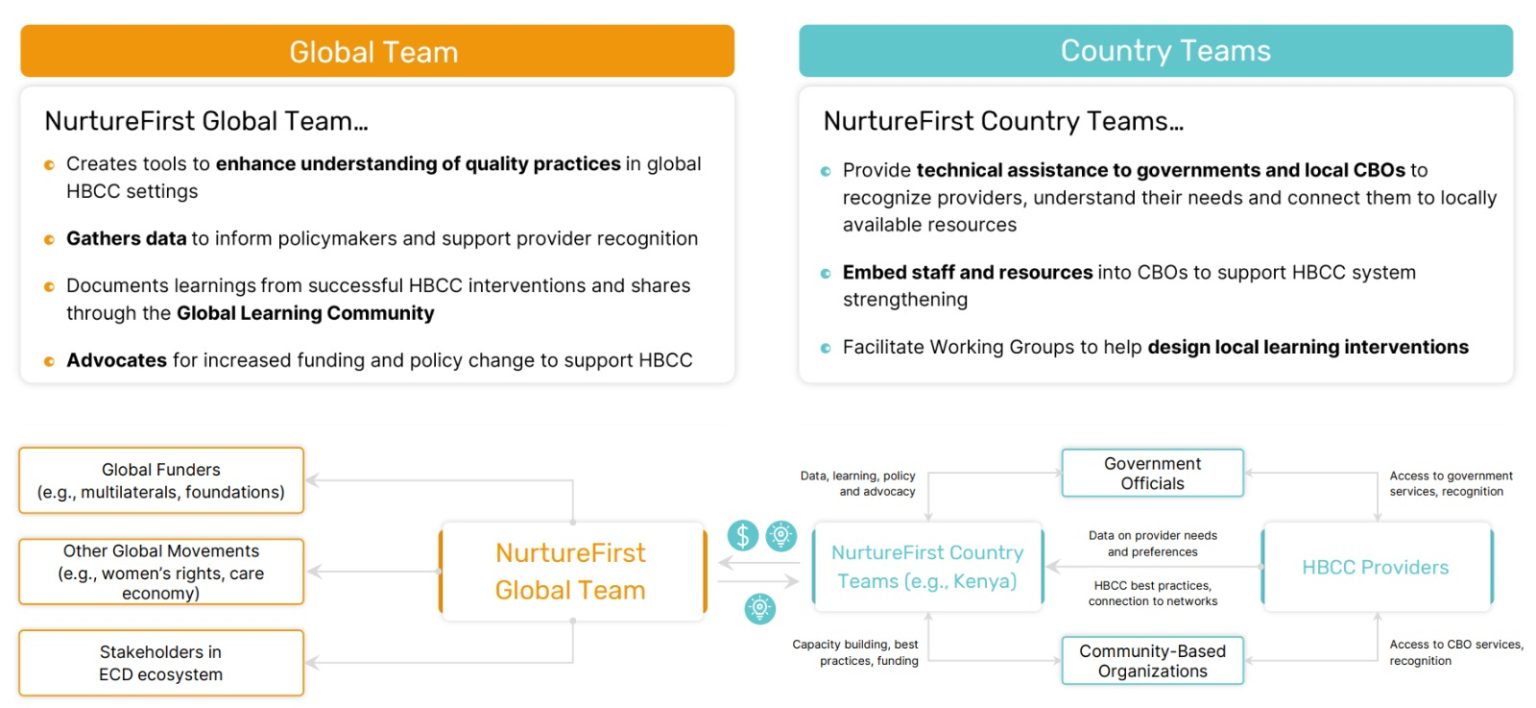
Tools to increase and measure quality practices in global HBCC settings
Data to support increased recognition of HBCC providers
Dissemination of learnings from successful HBCC interventions
Advocacy for increased funding and policy changes to support HBCC
NurtureFirst Local Teams provide:
Context-specific insights that drive the design and implementation of the HBCC system-strengthening pilots
Funding to embed NurtureFirst staff into the local Community-Based Organizations that are supporting HBCC system strengthening
Technical assistance to governments and local Community-Based Organizations to recognize providers,
understand their needs and
connect them to locally available resources
We start by mapping. In Kenya, we mapped the HBCC ecosystem and conducted detailed provider mapping across three counties. The result was the most comprehensive picture of Home-Based Childcare ever assembled in the country: 5,350 providers caring for 21,784 children. The data documents who providers are, what they earn, what support they receive, what policies surround them, and the children and families they serve.
We use that evidence to co-design targeted interventions with government partners and community organisations. We test approaches to quality, recognition and financing, each designed to function without ongoing NurtureFirst involvement. We advocate for policy, support provider networks, and generate evidence that shapes the global conversation on Home-Based Childcare. We are working in Kenya and are already providing technical assistance in Europe and Colombia.
Every intervention we design is built for handover. In the Sustain phase, NurtureFirst steps back and the system holds. Governments register and resource providers. Provider associations organise, advocate and shape policy on their own terms. Community structures maintain training and peer support. The tools and evidence we generate become public goods, free for other countries to adapt. We measure success by what improves long after our involvement ends.
In May 2026, at the Global Technical Forum on ECD Financing in Kigali, Rwanda, NurtureFirst, together with six global founding partner organisations, co-founded the Global Home-Based Childcare Alliance, of which NurtureFirst serves as the Global Secretariat.
The Alliance brings together organisations from Bangladesh (BRAC IED), Colombia (AEIOTu), South Africa (SmartStart), the United Kingdom (Tiney), the United States (NAFCC — National Association for Family Child Care), and Vietnam (OneSky), who designed the Alliance together with a shared goal: to drive a global movement elevating Home-Based Childcare.
The Alliance is open to organisations committed to advancing HBCC systems globally. The founding members are the start of a growing network.
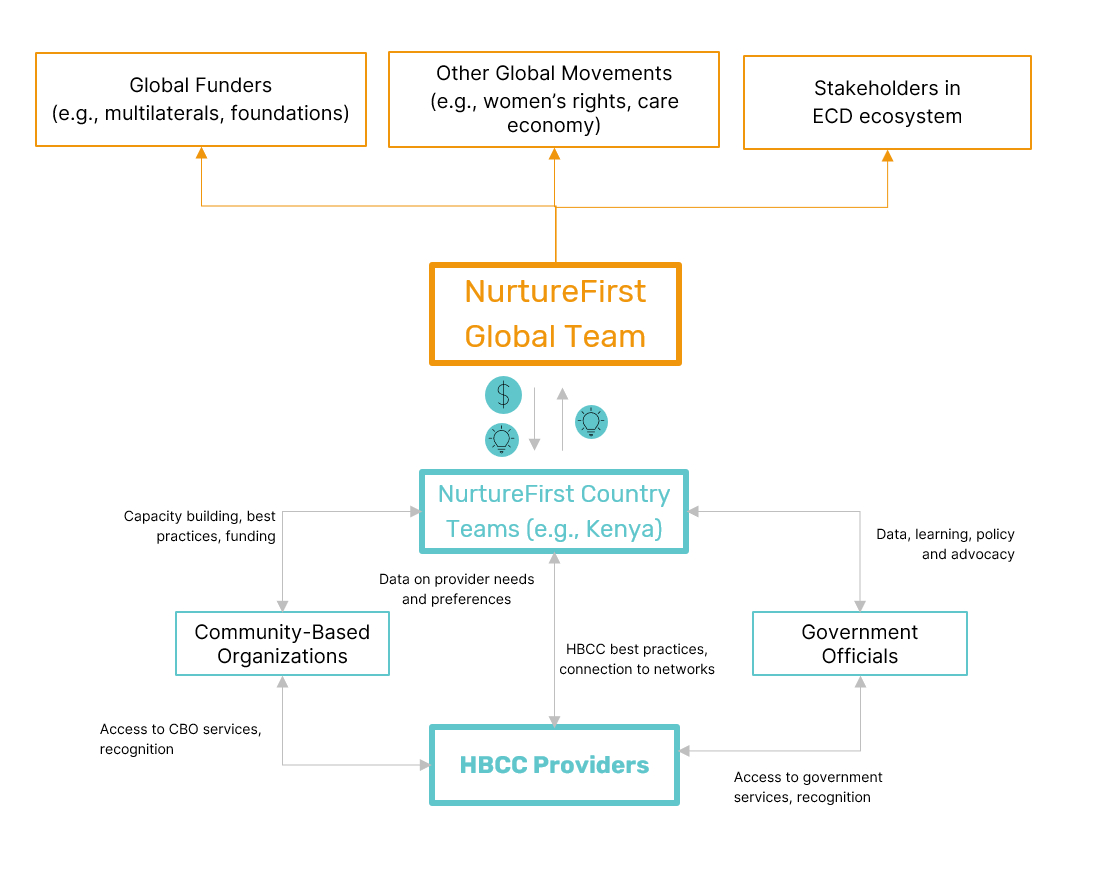
NurtureFirst convenes a Global Learning and Mobilization Community where we foster meaningful conversations on HBCC systems and behavior change. As a collaborative platform, we bring together system catalyzers and thought leaders, all united in the mission to elevate global quality in HBCC. Our discussions encompass pressing questions like how to influence governments and the global financial system to allocate resources to support HBCC initiatives. We also explore strategies to create cohesive movements centered around empowering women, the backbone of home-based childcare, and enabling them to actively participate in advocacy and policy-making.
Activities of our Global Learning & Mobilization Community include:
Creating best practice tools, including those that measure and enhance quality, and hosting a repository of knowledge for the HBCC sector
Movement building centered on creating global and national systems that support HBCC providers through training and joint advocacy and action
Documenting and sharing learning on successful HBCC approaches we learn from NurtureFirst country teams to share with ecosystem
of stakeholders
The Global Learning & Mobilization Community will be officially launched in 2025. Please reach out here if you are interested in learning more about NurtureFirst’s Global Learning and Mobilization Community.
